The Scout at the End of the Bar: What UK A&R Is Really Hearing at Open Mics in 2026
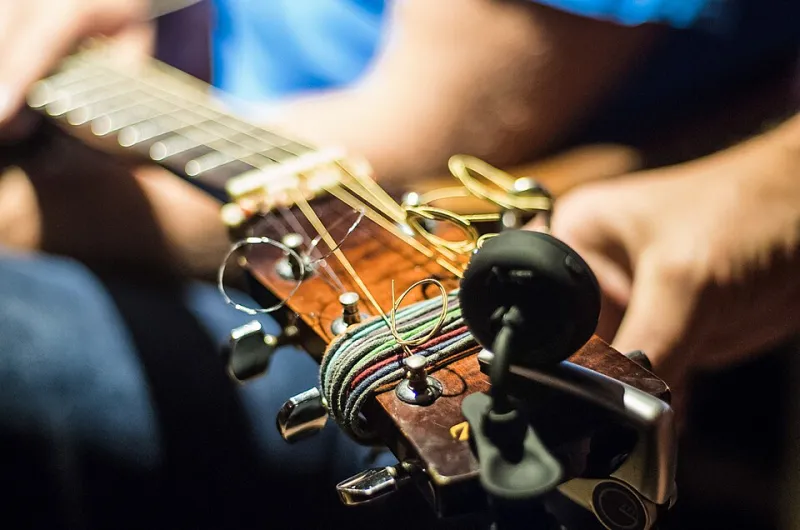
Photo: Ben Clarke, CC BY 3.0, via Wikimedia Commons
There is a particular sound in a British pub back room at 8.45pm on a Tuesday: a guitar being tuned by someone who is pretending not to be nervous, a pint glass landing on a table, and — increasingly — a quiet conversation near the fire exit about whether the person on stage has “a thing.” In 2026, that conversation is more likely to include someone with a label, a publisher or a management company attached. Not waving a contract. Just listening.
The return of A&R to open mics and midweek showcases has been gradual enough that it barely registered as a trend until it was everywhere. Through the late 2010s and early 2020s, the received wisdom was that scouts watched TikTok, waited for a playlist add, or let the algorithm do the legwork. The back room was for friends and cheap lager. Now the back room is, once again, a place where careers can start — or at least where they get a second look.
The notebook is not a spreadsheet
Ask anyone who has been on both sides of the bar what has changed and you get a similar answer: the numbers are no longer the first question. “I can see your monthly listeners before I leave the house,” says one scout who asked not to be named, because they are not supposed to be talking to journalists about strategy. “What I can’t see is whether you can hold a room when there are twelve people in it and two of them are talking.”
That is the thing about an open mic. It is not a showcase with a friendly crowd and a decent monitor mix. It is a test of whether a song survives contact with indifference. A&R types are watching for the moment a room that was not listening suddenly is. They are listening for the lyric that lands without a backing track, the between-song chat that suggests a personality rather than a persona, and the way an artist handles the bloke at the bar who requests “Wonderwall” during a quiet one.
It is also, inevitably, about songs. Not “content.” Not “vibe.” Songs. The return to the back room is partly a correction to the idea that a clip can carry a career. A clip can get you noticed; a song has to keep you there. Scouts are going back to the places where songs are still performed without a safety net because that is where they can hear whether the writing is doing the work.
The promoter’s new problem
For grassroots promoters, the renewed attention is a mixed blessing. On one hand, a room with a scout in it sells tickets. On the other, it changes the atmosphere. “You get a rush of people asking for slots when word gets out,” says a promoter who runs a weekly night in Leeds. “Then you get the ones who are not really ready, because they think the point is to be seen rather than to be good.”
The best promoters are protective of their rooms. They are not trying to turn a Tuesday open mic into a mini A&R showcase, because that ruins the thing that made it useful in the first place: the low stakes. The low stakes are what allow an artist to try a new song, fail, laugh, and try again. If every slot becomes an audition, the room stops being a room and starts being a queue.
There is also the question of pay. Open mics have always been a mixed economy — some pay a small fee, some pay in drinks, many pay in “exposure.” The return of industry attention has not automatically changed that. It has, if anything, made it easier for some venues to argue that the reward is the opportunity. That is worth watching. A healthy scene needs small stages that pay something, even if it is not much. Attention from labels should not become an excuse to keep it free.
What they are actually signing
It would be easy to frame this as a return to the old A&R story: the savvy scout, the raw talent, the late-night handshake. The reality is messier. The acts getting signed off the back of these nights are rarely straight-out-of-the-bedroom unknowns. They are often artists who have been gigging for years, have a small but real audience, and have already figured out how to be a person on stage. The open mic is not discovering them so much as confirming them.
That is probably healthy. The industry spent a decade being told that data would find the stars. Data is good at finding momentum. It is less good at finding the artist who is two songs away from being undeniable. The back room is where that second thing gets noticed. It is also where a scout can see whether an artist is a knob — which, in 2026, still matters more than people admit.
There is a risk, though. The more scouts turn up, the more the circuit bends around them. Promoters start programming for the industry rather than the room. Artists start writing for the scout rather than the song. The open mic becomes a showcase with worse lighting. That is the version of this story that ends with small stages being treated as unpaid R&D for labels. It is not inevitable, but it is possible.
The better version is simpler: the industry shows up, listens, and then gets out of the way. It pays for its drinks, does not hog the promoter’s time, and remembers that the point of a back room is that it belongs to the people in it. If A&R is going to be at the open mic — and in 2026 it clearly is — then the least it can do is act like a guest. The songs will do the rest.