The Curtain Track: Why a Band’s Walk-On Song Is the Most Honest Thing They’ll Play All Night
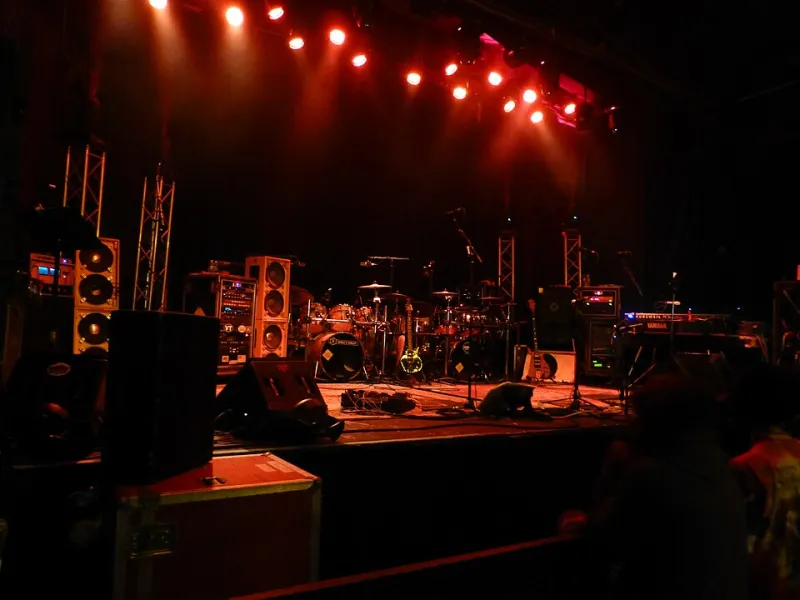
Photo: cp_thornton from Cleveland, Ohio, USA, CC BY 2.0, via Wikimedia Commons
The house lights drop. The chatter turns into a low, expectant hum. And then it arrives: the walk-on song. For the next 90 seconds or so, a band is not yet a band — they’re a rumour behind a curtain, a silhouette in the wings, a set of nerves being talked down by somebody else’s record. In 2026, that brief burst of borrowed sound has become one of the most revealing things about a UK live act.
The most honest minute and a half
You can learn a lot about a band from the song they choose to enter to. A Friend-of-the-Devil riff says we’re here to cause mild structural damage. A soaring cinematic number says we’ve watched too many arena documentaries and we’d like a piece of that, thanks. A novelty track says we know exactly how seriously to take ourselves, which is usually not very. And a band who walk on in silence? They’re telling you something too — usually that they’d rather spend the money on a new snare drum than a PRS cheque.
“The walk-on is the first joke, the first threat, or the first apology,” says Priya, a tour manager who has spent the last eight years shuttling bands around the UK’s 200-to-800-cap circuit. “It sets the temperature. If it’s too cool, the crowd stiffens up. If it’s too literal, they laugh at you rather than with you. The best ones feel like a hand on the shoulder.”
A licence to thrill (and a small invoice)
Walk-on music is not free. Even in a scruffy 150-cap room above a pub, recorded music played over the PA falls under the venue’s PRS for Music and PPL licences — but the practicalities get murkier when artists want a specific track, a custom edit, or something that isn’t already sitting in the house system. Tour managers talk about “clearing the walk-on” the way they talk about parking: boring, necessary, occasionally expensive.
Some acts sidestep the whole thing by using their own music — an intro track, a remix, a field recording of a bus door — which keeps costs down and messaging tight. Others treat the fee as part of the show’s fabric. “We spent £300 on a sync licence for a 40-second clip of a 1970s funk track,” says Tom, who plays guitar in a Sheffield four-piece currently touring a debut album. “It felt mad. But the crowd knows the song, and the moment it drops they’re already on our side. That’s cheaper than a support tour.”
At the grassroots end, the economics are less romantic. A band might use a royalty-free loop, a friend’s ambient project, or a track from the drummer’s other band. You can hear the join sometimes — the slightly tinny MP3, the abrupt fade — and somehow that’s part of the charm. The walk-on is a window into the budget before the first chord has even landed.
The playlist is the message
Then there’s the question of what the song says. A walk-on track can be a wink, a warning, a flex or an apology. In 2026, with TikTok snippets and algorithmic nostalgia shaping what audiences recognise, the choice has become a kind of shorthand. A Glasgow trio walking on to a 90s dance banger is making a different promise from a Bristol post-punk band entering to a field recording of seagulls and a dial tone.
“I’ve seen bands use the same walk-on for a decade,” says Marcus, a promoter in Manchester. “It becomes part of the brand. Fans film it. They wait for it. If you change it, you get complaints. That’s a lot of power for a song you didn’t write.”
That power cuts both ways. A track that reads as ironic in a small room can feel desperate in a bigger one. A sincere choice can land as naff if the crowd isn’t with you. The walk-on is a gamble taken before anyone has played a note — and unlike the setlist, it can’t be adjusted on the fly.
When the walk-on becomes the ritual
Fans have learned to read the signs. On the UK circuit, there are walk-on songs that trigger chants, clapping patterns, even choreographed phone-torch waves. The 90 seconds before the first chord has become its own kind of warm-up act, a shared breath before the room tips over into noise.
“There’s a band I follow where the walk-on is a football terrace chant,” says Ellie, a fan from Leeds who sees roughly 40 gigs a year. “The first time I heard it I thought the PA had broken. Now I look forward to it more than some of the songs. It’s like the crowd is singing them on.”
That ritual is fragile. Change the track and you break the spell; overuse it and it becomes a cue for the bar queue. The best walk-ons feel like a secret handshake — specific, slightly odd, and owned by the room rather than the algorithm.
Silence is also a statement
Not every band wants a soundtrack. Some walk on to nothing but the hum of the monitors and the sound of their own footsteps. It’s a power move, but also a practical one: no licence, no playlist politics, no risk of being upstaged by a song you didn’t write. In a year when every inch of the live experience seems to come with a cost or a content plan, the silent walk-on can feel almost radical.
“We tried music for one tour and it made us feel like we were introducing a boxing match,” says Sam, singer with a Nottingham band. “So we stopped. Now the quiet is the intro. You can hear people shushing each other. It’s terrifying and it’s ours.”
What 2026 sounds like before the first chord
The walk-on song is not the gig. It’s not even the first chord. But it’s the moment a room decides what kind of night it’s in for — and the moment a band shows its hand. Budget, humour, ambition, nerves: it’s all there in those 90 seconds, playing out while the lights are still down. Next time you’re at a show, listen to what comes before the first note. It might be the most honest thing you hear all night.